Energy & Resources

Predictive Maintenance Intelligence for Gas Compression Systems

Leading Energy Operator

Timeline: 10 months
Team: 7-10 specialists

KEY IMPACT

Reduced unplanned downtime through early detection, increased maintenance efficiency, and provided engineers with real-time anomaly dashboards for operational awareness and failure prevention.

The Challenge

A leading energy operator running a fleet of gas compression assets across multiple production sites was facing recurring unplanned shutdowns that were eroding both production uptime and maintenance budgets. Each unscheduled compressor outage cost six figures in lost throughput, plus the secondary cost of expedited parts, overtime crew dispatch, and re-certification of safety systems before restart. The root cause was not a lack of sensor data — the compressors were heavily instrumented with PI historian feeds capturing turbine pressure, lube oil pressure, discharge temperature, seal gas differentials, vibration, and dozens of other signals at sub-minute intervals. The root cause was that nothing was systematically reading that data. Field engineers relied on manual inspection of PI dashboards and spreadsheet-based performance tracking, which made it almost impossible to identify the slow, multi-day drift patterns that precede most compressor failures. Operational parameters were also being logged inconsistently across sites, with different naming conventions and sample rates, so a deviation that was obvious on one asset would be invisible on a sister unit. Engineers knew the warning signs were in the data but couldn't see them until after the failure had happened. The operator had previously trialled a generic anomaly detection product from a major vendor, but it produced too many false positives to be useful and could not be tuned to the specific operating envelopes of each compressor stage. They needed a solution that combined engineering domain knowledge with machine learning, and that ran on the data platform they had already standardised on.

Our Solution

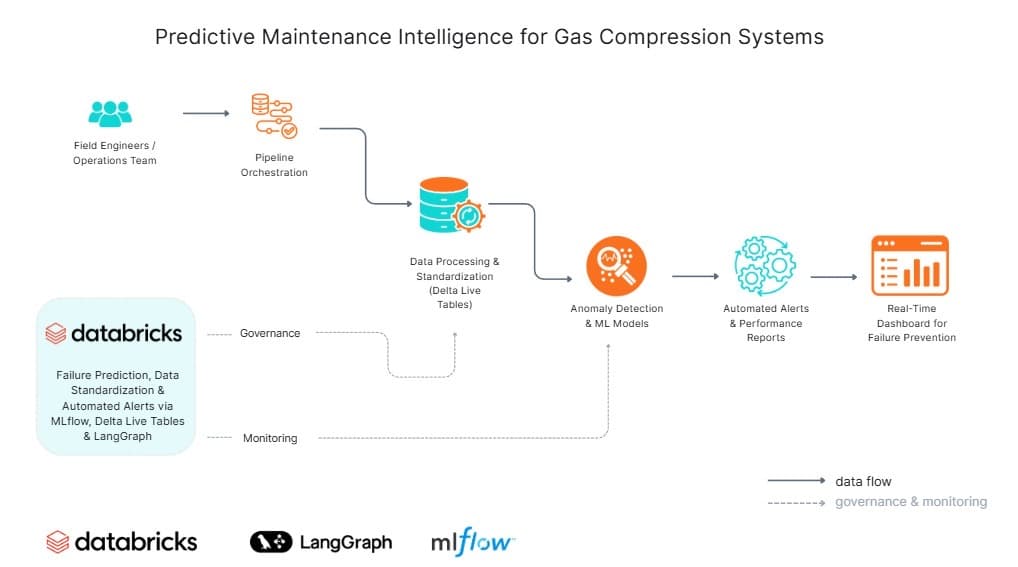
We designed an automated predictive maintenance pipeline architecture on Databricks that integrated real-time PI system data with historical compressor telemetry into a single governed lakehouse. The first stage was data standardisation: a Delta Live Tables pipeline ingested PI streams from every site, normalised tag names and units against a canonical schema, and produced a clean Bronze→Silver→Gold flow that engineers across sites could trust. On top of the standardised data we layered predefined engineering rules for each operational stage of the compression cycle — covering Enclosure, Pre-lube, Yard Valve, Ignition, and On-load conditions. These rules encoded the operator's own SME knowledge about safe operating ranges and were the first line of defence: any deviation outside normal envelopes generated an immediate alert with full context, eliminating an entire class of failures that didn't require ML to catch. For the more subtle degradation patterns we built a machine learning layer powered by MLflow-tracked XGBoost classifiers and time-series anomaly detection models including autoencoders. These models tracked sensor trends like voltage stability, seal gas pressure, and turbine differential pressure to identify early signs of failure up to seven days in advance of an actual fault. Each model was versioned in MLflow with its training data, hyperparameters, and evaluation metrics, so that engineers could trace any prediction back to a specific model version and dataset. LangGraph orchestration tied the rules engine and ML models together, triggering automated alerts when either layer flagged an issue and generating daily performance summaries for engineers across every monitored asset. The summaries included plain-language explanations of why a particular alert was raised and what historical pattern it most resembled, dramatically reducing the time engineers spent triaging false alarms. The entire pipeline was built with Unity Catalog governance, so every model, dataset, and alert had clear lineage and access controls — important for an organisation where safety-critical decisions need to be auditable.
Predictive Maintenance Intelligence Architecture for Gas Compression Systems

Predictive Maintenance Intelligence Architecture showing data flow from field engineers through pipeline orchestration, anomaly detection, and real-time dashboards

Results & Outcomes

Reduced unplanned downtime through early detection of pressure and temperature anomalies up to 7 days in advance

Increased maintenance efficiency, allowing proactive scheduling of compressor overhauls instead of reactive emergency callouts

Increased prediction accuracy for early fault detection across over 10,000 sensor data points per day per asset

Provided engineers with real-time anomaly dashboards for operational awareness and failure prevention

Technologies Used

Databricks
Delta Live Tables
MLflow
PySpark
XGBoost
PI System Integration
Unity Catalog
Autoencoders

Ready for Similar Results?

Let's discuss how we can help transform your organisation's data and AI capabilities.

Predictive Maintenance Intelligence for Gas Compression Systems - Energy & Resources | Get AI Ready