The Challenge
A leading retail enterprise had reached the point in its AI maturity where every business unit wanted to build its own predictive models, and they were doing it in isolation. The merchandising team had built a demand forecasting pipeline. Marketing had stood up a propensity model. Supply chain was experimenting with a stockout predictor. Customer service had trained a churn model. Each of these had been built on slightly different data extracts, with different feature definitions, different deployment patterns, and different governance assumptions.
The symptoms were exactly what enterprise data leaders dread. Redundant workloads were burning compute budget. Inconsistent feature definitions meant the same customer could be classified differently by two different models. Fragmented deployment pipelines meant that productionising a new model took weeks of bespoke engineering each time. And the corporate AI governance team had no way to enforce model risk policies across this sprawl, which was rapidly becoming a regulatory exposure as the enterprise expanded into new jurisdictions with stricter AI rules.
Leadership had committed to a unified platform strategy, but knew that simply mandating a tool would not work, the business units would only adopt it if it made their lives easier than the status quo. The platform needed to standardise governance and operations without slowing teams down.
Our Solution
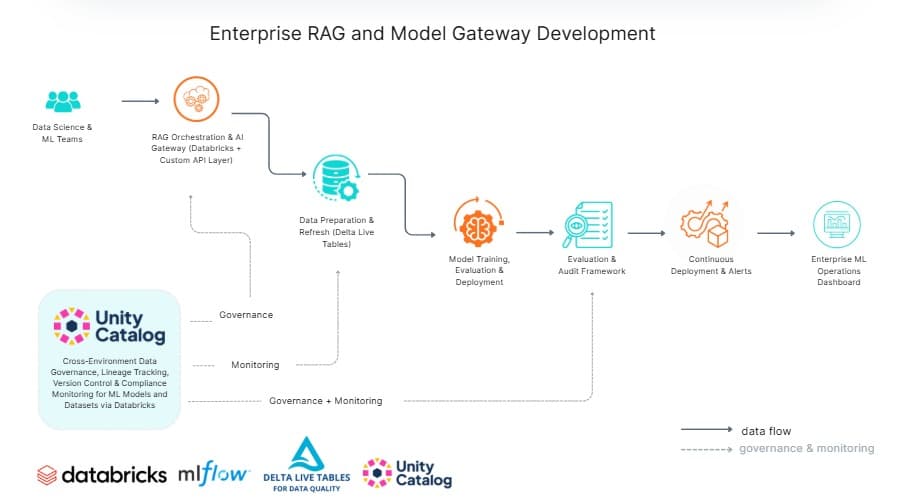
Our team architected a Databricks-powered Enterprise RAG solution: a unified environment integrating data preparation, model training, evaluation, and deployment under one scalable framework with built-in AI Guardrails.
The planning stage emphasised modular MLOps design with strong governance controls. Unity Catalog provided access management, lineage tracking, and versioned datasets across every environment, so a feature defined once could be reused everywhere with confidence. We deliberately designed the platform around composable building blocks rather than a monolithic framework, so each business unit could opt in incrementally without rewriting their existing pipelines on day one.
We planned a custom AI Gateway that orchestrated model serving through a consistent API layer. Teams could publish a model once and have it available to every consumer in the enterprise behind a versioned, rate-limited, monitored endpoint. The Gateway also enforced AI Guardrails, content filters, PII redaction, prompt injection defences, and per-model usage policies, automatically, so individual teams did not have to reinvent these controls for every project. This was the carrot that drove adoption: teams got production-grade safety features for free by using the platform.
Model performance monitoring ran through MLflow Evaluate, with continuous evaluation against canary datasets for every deployed model. Delta Live Tables handled automated data refresh, ensuring each production model remained synchronised with the latest data streams without manual intervention. CI/CD pipelines automated promotion across environments with policy-as-code gates that enforced governance requirements before any model could reach production.
The resulting architecture transformed the enterprise's AI operations into a continuous innovation pipeline with auditability, scalability, and governance built into the foundation rather than bolted on afterwards.
Enterprise RAG and Model Gateway Development Architecture showing RAG orchestration, data preparation with Delta Live Tables, model training and evaluation, continuous deployment, Unity Catalog governance, and enterprise ML operations dashboard